
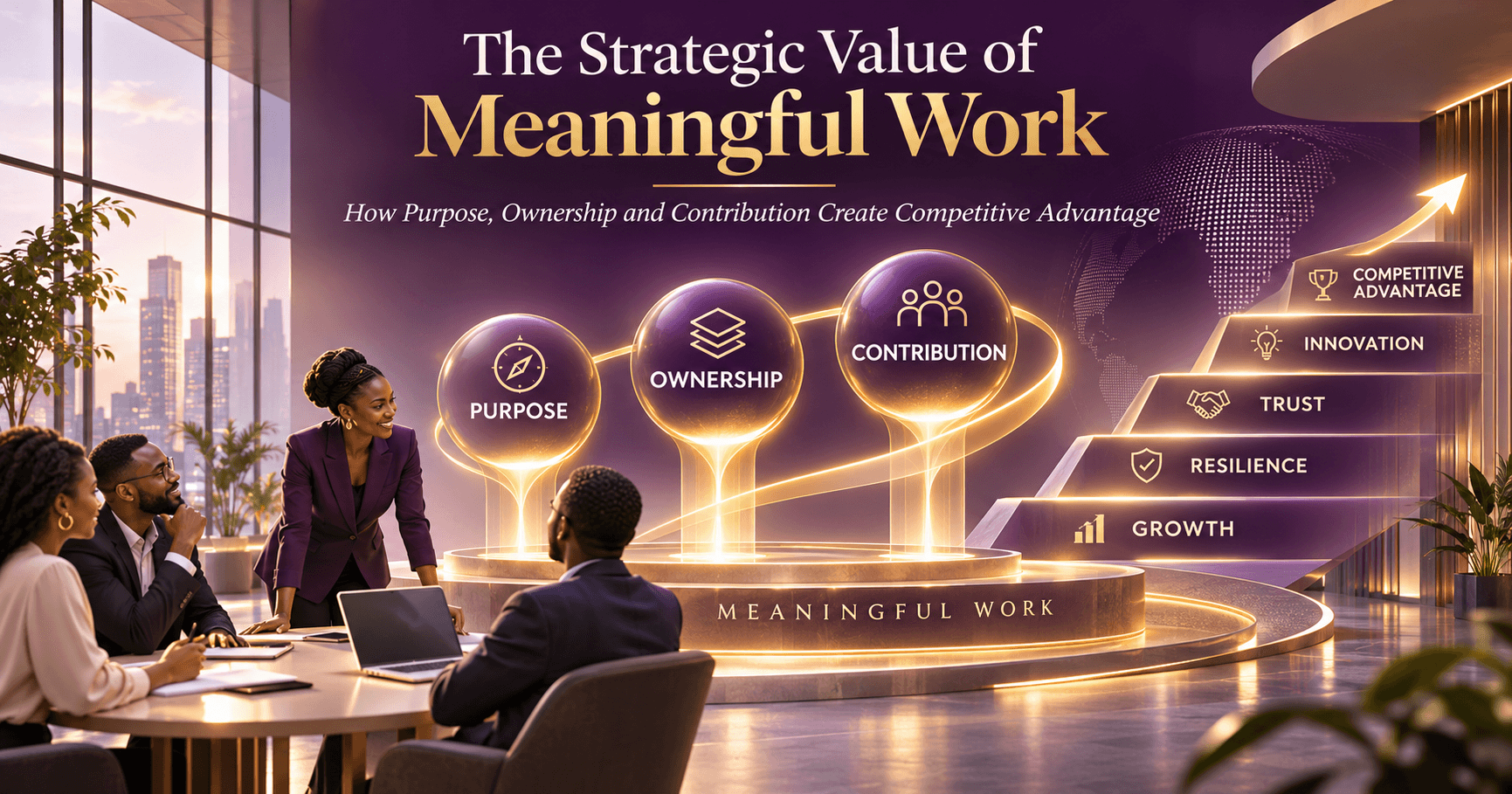
How Purpose, Ownership and Contribution Create Competitive Advantage
TEOARIS INSIGHTS | NOVEMBER 2026
What makes one employee go beyond the minimum requirements of a job while another, possessing comparable qualifications and experience, does only what is necessary to get through the working day?
Why do some people approach problems with curiosity, initiative and a determination to find solutions, while others simply escalate the same problems and await instructions?
And why do certain organisations consistently achieve more with their people than competitors with similar resources, technologies and operating conditions?
The answers are rarely straightforward. Differences in competence, leadership, incentives, organisational systems and individual circumstances all matter.
But there is another factor that deserves considerably more attention in business strategy and organisational performance discussions.
The extent to which people find meaning in the work they do.
For many organisations, meaningful work is still treated primarily as an employee engagement or human resources concern. Something associated with job satisfaction, motivation, personal fulfilment and workplace culture.
Yet its implications extend much further.
Meaningful work can influence how employees exercise judgement, respond to challenges, serve customers, collaborate with colleagues and contribute to organisational improvement.
And when these behaviours become embedded across an organisation, they can help create something of substantial strategic value: a workforce whose collective contribution becomes a source of competitive advantage.
Beyond Earning a Living: What Makes Work Meaningful?
People work for many reasons.
For some, employment provides financial security. For others, it offers professional advancement, social identity, intellectual stimulation or opportunities to develop their abilities.
Many people seek some combination of these benefits.
There is nothing inherently wrong with working primarily to earn a living. Financial compensation remains fundamental to the employment relationship.
But there is an important difference between work that merely provides an income and work that also creates a sense of purpose, contribution or accomplishment.
Meaningful work exists when individuals perceive what they do as worthwhile and significant.
They understand why their contributions matter, recognise the value created through their efforts and experience some sense of accomplishment from performing their responsibilities effectively.
Importantly, meaningful work does not necessarily require an extraordinary mission, a prestigious profession or a career dedicated to changing the world.
Consider a logistics officer responsible for coordinating the movement of imported medical equipment.
At one level, the job involves shipment documentation, customs procedures, communication with service providers and delivery schedules.
At another level, the officer is helping ensure that important medical equipment reaches healthcare providers who depend on it.
Both descriptions concern precisely the same job.
But the second connects daily activities to their wider significance.
Similarly, an accountant is not simply processing figures. An operations supervisor is not merely monitoring tasks. A customer service representative is not just answering enquiries.
Each contributes, directly or indirectly, to outcomes that matter to customers, colleagues, investors and the wider organisation.
Meaningful work begins when employees understand not only what they are required to do, but why doing it well makes a difference.
That understanding can change the relationship between the individual and the job.
The Evidence: Meaning Matters to Performance
The relationship between meaningful work and organisational outcomes is supported by a growing body of research.
In November 2025, Gallup and Stand Together published findings from a survey of 4,475 working adults in the United States.
Employees reporting a strong sense of purpose at work were 5.6 times as likely to be engaged as employees with a low sense of purpose.
Among employees with strong work purpose, 50% were engaged, compared with only 9% of those reporting low work purpose.
The study also found substantially lower reported burnout and intentions to seek alternative employment among workers experiencing stronger purpose.
These are associations rather than proof that purpose alone produces better results. Nevertheless, they reveal an important relationship between how people experience their work and how connected they are to their organisations.
A broader meta-analysis published in the Journal of Management Studies, examining 44 studies involving 23,144 participants, also found strong associations between meaningful work, employee engagement, organisational commitment and job satisfaction, alongside smaller positive associations with reported job performance.
More recent experimental research adds an interesting dimension.
A 2025 working paper by Nava Ashraf, Oriana Bandiera, Virginia Minni and Luigi Zingales examined the effects of a workplace purpose initiative among 2,976 white-collar employees.
The researchers found that the intervention improved organisational performance, partly because lower-performing employees either improved their performance or left the organisation.
The findings suggest that meaningful work can influence more than employees’ attitudes. Under certain conditions, it can also shape workforce composition and performance outcomes.
For business leaders, the important conclusion is not that purpose can substitute for competence, incentives or effective management.
Rather, meaning is another dimension of organisational performance that leaders cannot afford to overlook.
From Meaningful Work to Competitive Advantage
Competitive advantage is traditionally associated with factors such as cost efficiency, product differentiation, technological capabilities, market access, intellectual property and superior business models.
These remain fundamental.
However, organisations do not compete through strategies and resources alone.
They compete through the collective decisions, actions, capabilities and behaviours of the people responsible for executing those strategies.
Two companies may purchase similar technologies, recruit from the same labour market, operate comparable facilities and adopt similar business processes.
Yet their results may differ significantly. One may deliver more reliable service, respond faster to customer needs, resolve operational challenges more effectively and demonstrate greater organisational adaptability.
What creates this difference?
Sometimes, the explanation lies in capabilities and behaviours that are difficult to observe from outside the organisation. And this is where meaningful work can become strategically important.
The Difference Between Compliance and Contribution
Every organisation needs employees to fulfil their formal responsibilities.
But exceptional organisational performance frequently depends on contributions that cannot be exhaustively specified in job descriptions.
- A customer service employee who recognises an emerging problem and acts before it becomes a complaint.
- A warehouse supervisor who identifies a recurring source of operational waste and proposes a more efficient process.
- A finance officer who questions a transaction because it appears inconsistent with the organisation’s risk appetite.
- A junior employee who challenges a flawed assumption before it becomes an expensive management decision.
These actions require more than technical competence. They require attentiveness, judgement, initiative and a willingness to assume responsibility for outcomes.
A meaningful connection to work can strengthen these behaviours because employees see themselves as contributors to results rather than simply performers of assigned activities.
The distinction matters.
Compliance helps organisations maintain acceptable standards. Meaningful contribution helps them improve those standards.
Of course, meaningful work does not guarantee initiative. Employees also need appropriate authority, competence, information and management support.
But an organisation that combines these conditions with a workforce that understands the significance of its contributions has an important foundation for superior performance.
When Employees See the Impact of Their Work
One of the most revealing demonstrations of the relationship between meaning and performance comes from organisational psychologist Adam Grant and his fellow researchers.
In a 2007 study involving university fundraising employees, researchers examined what happened when callers were given an opportunity to interact briefly with someone who had benefited from the scholarships their fundraising efforts supported.
The results were striking.
Following the interaction, the employees in the intervention group increased their phone time by 142% and the money they raised by 171%, while the comparison groups did not experience similar improvements.
These findings should not be interpreted as a universal formula for increasing productivity.
But they illustrate an important principle.
Sometimes, the most powerful way to improve employees’ connection to their work is not to give them another motivational speech.
It is to help them see the difference their work makes.
For businesses, this opens interesting possibilities.
- What if employees regularly heard how customers benefited from their contributions?
- What if operational teams understood how improvements in turnaround time affected customer profitability?
- What if employees responsible for quality control saw the consequences of their work for product safety, brand reputation and customer trust?
- What if business leaders connected individual performance measures to outcomes that employees genuinely understood and valued?
An organisation’s purpose becomes more meaningful when it is translated from abstract corporate language into everyday experiences.
People are more likely to appreciate the significance of their work when they can see whom it serves, what it improves and why it matters.
Meaningful Work as an Organisational Capability
There is, however, an important strategic distinction between having employees who find their jobs meaningful and building an organisation in which meaningful contribution is consistently encouraged.
An individual employee may be deeply committed to their work despite operating in a poorly managed organisation. Such commitment can produce admirable personal performance. But it does not necessarily translate into sustainable competitive advantage.
For meaningful work to become a source of organisational strength, it must be reinforced by the way the business is designed and managed. Employees need clarity about priorities and expected outcomes.
They need opportunities to exercise judgement, develop competence and experience ownership of results. They need leaders who explain the significance of work rather than merely issuing instructions.
They need processes that enable rather than frustrate effective performance.
And they need reasonable confidence that worthwhile contributions will be recognised and that performance expectations will be fairly applied.
When these elements reinforce one another over time, the organisation begins to develop habits and capabilities that are not easily replicated.
Competitors may imitate a company’s products, technologies, policies or formal organisational structures. It is considerably harder to reproduce an embedded system of trust, professional judgement, customer commitment, accountability and continuous improvement.
This is where meaningful work moves beyond an individual psychological experience and becomes part of an organisation’s institutional capability.
The competitive advantage does not arise simply because employees feel good about their work.
It arises because their sense of purpose is translated into distinctive behaviours, capabilities and results that customers value.
The Leadership Responsibility: Making Work Worthwhile
If meaningful work can strengthen organisational performance, what responsibilities does this place on leaders?
First, leaders must ensure that employees understand the relationship between their roles and the organisation’s broader objectives.
This goes beyond communicating corporate vision statements during retreats or displaying organisational values on office walls.
It requires helping people understand how their work contributes to actual business outcomes.
Second, leaders must give employees opportunities to influence the results for which they are accountable.
There is little value in encouraging ownership while denying people the authority to make reasonable decisions.
Third, managers must provide opportunities for development and accomplishment.
Work becomes more meaningful when people can see themselves becoming more capable, solving increasingly complex problems and making worthwhile contributions.
Fourth, employees must receive feedback that explains the significance of their performance.
Feedback should not focus exclusively on whether targets were achieved. It should also help people understand what their achievements mean for customers, colleagues and the organisation.
Finally, the organisation’s practices must reinforce its stated purpose.
A company that speaks passionately about customer service but rewards employees exclusively for sales volumes may inadvertently encourage behaviours that undermine customer trust.
Similarly, a business that promotes innovation while punishing every unsuccessful experiment creates a contradiction between its aspirations and its management practices.
Purpose cannot be sustained through communication alone. It must be reflected in what leaders prioritise, reward, tolerate and practise.
A Necessary Caution: Meaning Must Not Become a Substitute for Fairness
There is another side to the meaningful work conversation that business leaders must not ignore.
An employee’s sense of purpose should never become a justification for inadequate compensation, excessive workloads, unrealistic expectations or poor working conditions.
Meaningful work and decent work are not competing ideals.
They should reinforce each other.
An organisation cannot credibly celebrate the dedication of its employees while systematically exploiting that dedication.
Neither should leaders assume that every employee must discover a personal calling through their job.
For some people, work will remain primarily a means of providing for themselves and their families, and that is entirely legitimate.
The leadership responsibility is not to manufacture emotional attachment to the organisation.
It is to ensure that people can work with dignity, understand the value of their contributions, develop their abilities and participate in achieving worthwhile results.
Ultimately, the strongest organisations seek a productive balance between individual fulfilment and organisational performance.
That balance is what makes meaningful work sustainable.
The Strategic Question for Business Leaders
As competition intensifies, many organisations respond by investing in technology, pursuing new markets, restructuring operations, reducing costs or strengthening marketing capabilities.
These initiatives can be necessary and valuable.
Yet organisations may overlook one of the most significant sources of performance improvement already within their reach: the unrealised potential of their existing workforce.
This is not simply a question of whether employees are working hard enough.
It is whether the organisation has created sufficient opportunities for people to make contributions commensurate with their capabilities.
Do employees understand how their work creates value?
Do they see themselves as responsible for outcomes or merely accountable for completing assigned tasks?
Are they encouraged to exercise professional judgement and improve how work is done?
Do managers help employees recognise the significance of their contributions?
And does the organisation translate this collective commitment into measurable improvements in customer experience, productivity, innovation and execution?
These are not peripheral human resource questions.
They are questions about how an organisation creates and sustains competitive advantage.
Conclusion: The Advantage That Cannot Simply Be Purchased
Organisations will always need sound strategies, capable leaders, efficient processes, appropriate technologies and disciplined execution.
Meaningful work is not a substitute for any of these requirements.
But it can influence how effectively people use them.
When individuals understand the significance of their responsibilities, experience ownership of outcomes and recognise the value created through their efforts, their relationship with work can change.
They may become more attentive, more committed, more willing to exercise judgement and more invested in the success of the organisation.
When supported by effective leadership and sound organisational systems, these behaviours can accumulate into distinctive institutional capabilities.
And those capabilities can become a durable source of competitive strength.
Ultimately, competitive advantage is not only about what an organisation possesses. It is also about what its people are willing and able to accomplish with what it possesses.
That is the strategic value of meaningful work.