
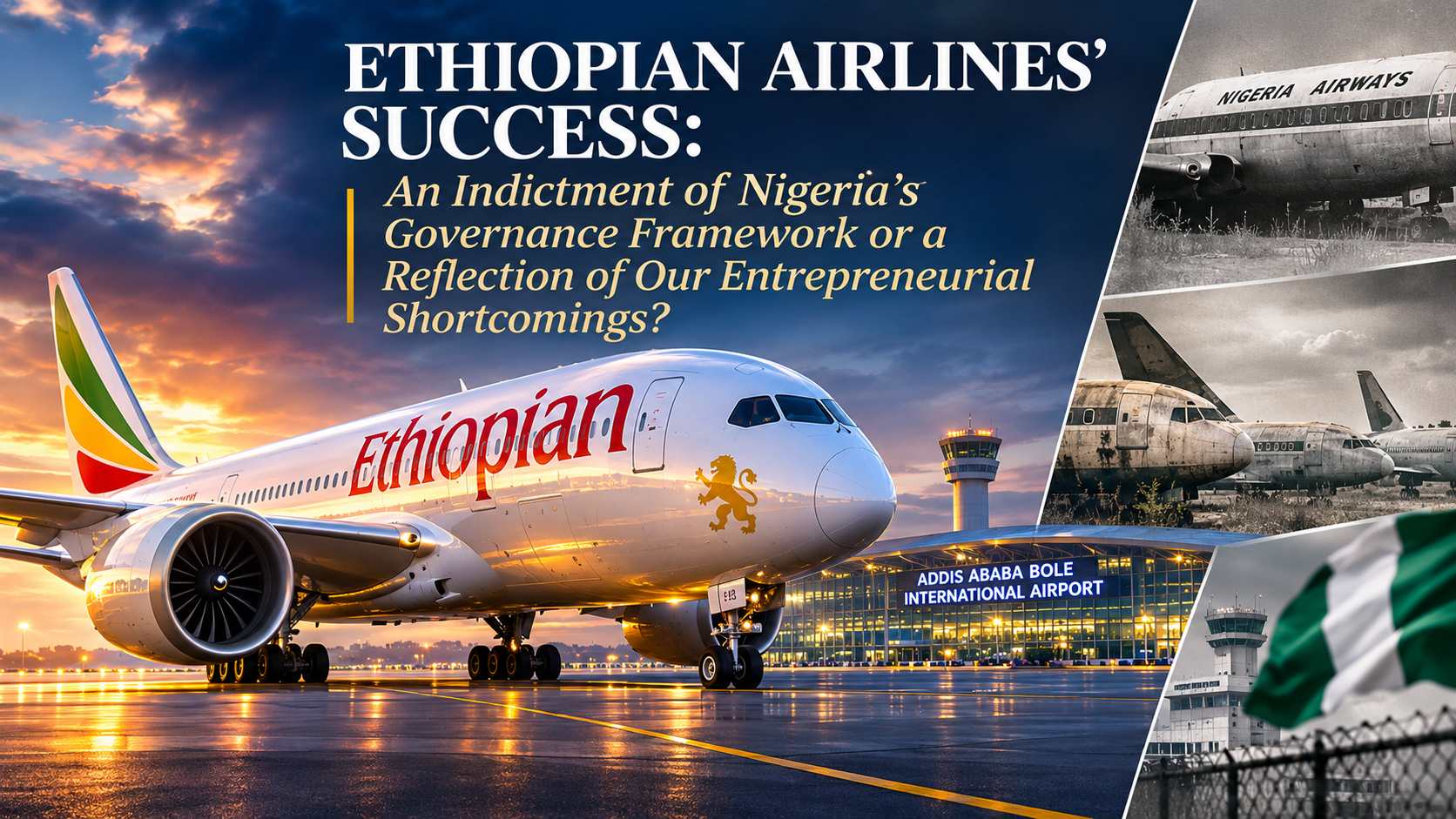
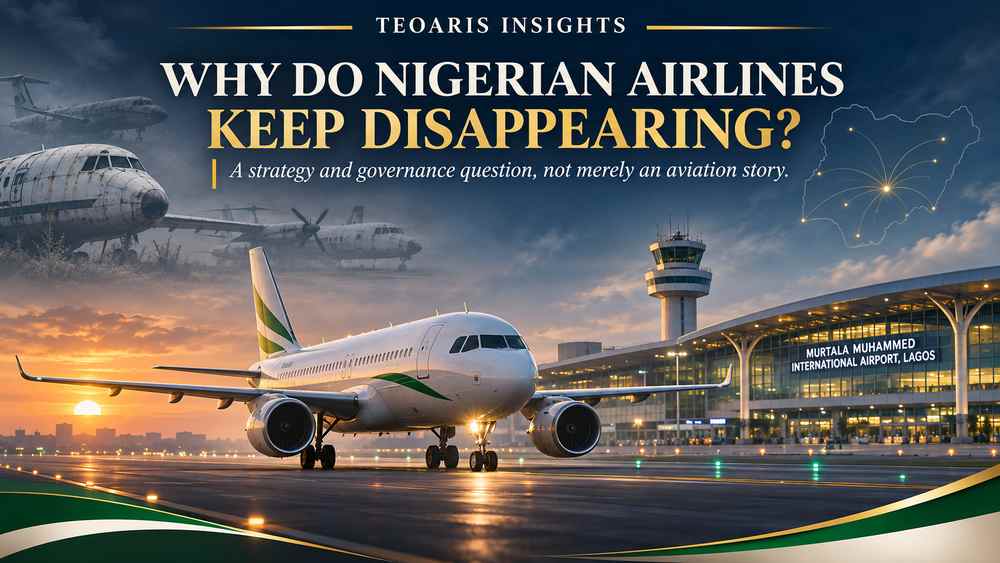
TEOARIS INSIGHTS | STRATEGY, GOVERNANCE & ENTERPRISE DEVELOPMENT
What the contrasting fortunes of Ethiopian and Nigerian airlines reveal about building enduring enterprises.
e Continent. Two Contrasting Journeys.
In 1946, Ethiopian Airlines commenced commercial operations with five aircraft.
Twelve years later, in 1958, Nigeria established Nigeria Airways.
Both countries recognised aviation as an important instrument of national development, international connectivity and economic transformation. Both invested in national carriers with ambitions extending beyond their domestic markets.
Eight decades after Ethiopian Airlines commenced operations, the contrast is striking.
Nigeria Airways was liquidated in 2003. Several generations of private Nigerian airlines have subsequently emerged, generated considerable excitement, expanded their operations and eventually disappeared or experienced significant financial distress.
Ethiopian Airlines, meanwhile, has evolved into Africa’s largest airline and one of the continent’s most remarkable corporate success stories.
In its 2025/26 financial year, the airline generated $9.1 billion in revenue, representing approximately 20% annual growth. According to its September 2026 fact sheet, it transported 20.43 million passengers and nearly 898,000 tonnes of cargo, while employing more than 21,000 full-time employees.
Its annual revenue has grown more than fourfold since the 2012/13 financial year.
And perhaps most remarkably, Ethiopian Airlines remains wholly owned by the Ethiopian government.
How do we explain this extraordinary divergence?
Is Ethiopian Airlines’ success an indictment of Nigeria’s public governance framework? Does it expose inadequacies in the strategic orientation, managerial competence and governance of our aviation enterprises? Or does it reflect a more fundamental interplay between the quality of national institutions and the capabilities of individual businesses?
These are questions that deserve considerably more intellectual attention than they typically receive.
1. Same Economy. Different Business Economics.
One of the limitations of interpreting business performance primarily through macroeconomic indicators is that businesses do not experience the economy in exactly the same way.
The World Bank’s October 2026 Nigeria Development Update acknowledges improvements in Nigeria’s macroeconomic performance while highlighting continuing pressures on household purchasing power.
An improving national economy does not automatically translate into improving conditions for every business.
Consider two Nigerian manufacturers exposed to the same exchange-rate movements. One relies extensively on imported raw materials; the other has developed reliable local sourcing arrangements. One carries substantial foreign currency obligations; the other generates sufficient domestic cash flow to finance its operations.
Similarly, two restaurant chains may face the same food inflation and energy costs but possess fundamentally different pricing models, customer segments, supply-chain capabilities and operating structures.
They operate within the same national economy, but not within the same business economics.
This does not imply that every business failure reflects poor management. Some external shocks can overwhelm even well-managed enterprises. Access to capital, inherited liabilities, regulatory constraints and industry structures also influence outcomes.
Nevertheless, the operating environment should not become an all-purpose explanation for organisational underperformance.
For leadership teams, the more productive question is not simply how difficult the environment has become, but which aspects of their business models make them particularly vulnerable to it, and which could give them an advantage.
The Government Ownership Paradox
One of the conclusions frequently drawn from Nigeria’s experience with publicly owned enterprises is that government has no business being in business.
The collapse of Nigeria Airways, alongside the difficulties experienced by several other Nigerian public enterprises, has understandably reinforced this view.
Yet Ethiopian Airlines presents a compelling challenge to that proposition.
The Ethiopian government has retained ownership of the airline through successive administrations, profound political transitions, economic difficulties, internal conflicts and changes in the country’s political system.
What appears to have distinguished Ethiopian Airlines is not the absence of government ownership, but the institutional arrangements through which that ownership has been exercised.
Research by the World Bank, UN Trade and Development and other institutions has highlighted the importance of commercial orientation, professional management and operational autonomy in the airline’s development.
The distinction is fundamental.
Government ownership need not translate into government interference in operational decisions. Public investment need not come at the expense of commercial discipline. And a national development mandate need not be incompatible with profitability.
Conversely, private ownership does not automatically guarantee competent management, effective governance or commercial sustainability.
An enterprise can be privately owned and still suffer from excessive owner interference, weak accountability, poor investment decisions and inadequate financial discipline.
Perhaps the more important question, therefore, is not whether government should own an airline, but whether the institutional framework exists to enable an airline to function as a commercially viable enterprise, irrespective of who owns it.
Ownership is not a substitute for governance. Neither is privatisation a substitute for managerial competence.
Building an Airline Versus Building an Aviation Enterprise
A closer examination of Ethiopian Airlines reveals something that is easily overlooked.
Ethiopia has not merely built an airline. It has built an aviation enterprise with an increasingly integrated ecosystem of complementary businesses and capabilities.
Today, Ethiopian Airlines Group operates across passenger transportation, cargo and logistics, aircraft maintenance, repair and overhaul, aviation training, airport services, ground handling, in-flight catering and hospitality.
These are not simply unrelated businesses assembled under a corporate umbrella.
They constitute an interconnected system of capabilities that support the group’s competitive position.
Its aviation training institutions develop the professionals required to sustain its operations. Its maintenance facilities provide technical support while generating opportunities to serve third-party airlines. Its cargo business diversifies revenue and connects Ethiopian producers to international markets. Its airport and ground services complement the expansion of its global network.
The strategic significance of this architecture became particularly evident during the COVID-19 pandemic.
While the collapse in passenger demand placed airlines across the world under enormous financial pressure, Ethiopian Airlines was able to redirect considerable operational capacity towards cargo transportation, drawing on capabilities it had developed before the crisis.
Its resilience was not simply a product of management’s response to the pandemic. It was also a consequence of strategic investments made long before the pandemic occurred.
This raises an important question for Nigerian aviation entrepreneurs.
Are we primarily building businesses that transport passengers from one destination to another, or are we deliberately building aviation enterprises with the capabilities, partnerships and revenue structures necessary to remain competitive through successive industry cycles?
There is nothing inherently wrong with operating a focused passenger airline. Not every carrier should attempt Ethiopian Airlines’ level of integration.
The strategic imperative, however, is to understand the critical dependencies of one’s business model and deliberately develop the capabilities or partnerships required to manage them.
A business model is only as resilient as the capabilities and relationships upon which it depends.
The Foresight to Build Indigenous Capabilities
Perhaps one of the most instructive aspects of the Ethiopian Airlines story is how early the country recognised the strategic importance of indigenous capability development.
Ethiopian Airlines initially benefited from a technical and management partnership with America’s Trans World Airlines (TWA).
However, external expertise was not treated merely as a permanent solution to domestic capability deficiencies.
It provided a foundation for developing Ethiopian expertise.
By 1956, just ten years after commencing operations, Ethiopian Airlines had established its aviation academy. In 1957, it established its own aircraft maintenance facility. A pilot training school followed in 1964.
These investments preceded the enormous scale the airline enjoys today.
In other words, Ethiopian Airlines did not wait until it became a large enterprise before investing in the capabilities required to become one.
It understood, relatively early in its journey, that sustainable growth in a technically demanding industry required more than access to aircraft and capital.
It required a deliberate accumulation of knowledge, expertise, systems and institutional competence.
Contrast this with the continuing dependence of much of Nigeria’s aviation industry on overseas facilities for major aircraft maintenance, foreign currency for critical operational inputs and international suppliers for essential services.
Nigeria has developed important capabilities of its own, and indigenous maintenance providers and aviation training institutions deserve recognition. But substantial gaps remain.
The consequence is not merely higher operating expenditure. It is exposure to external dependencies that can disrupt operations, weaken financial resilience and constrain strategic flexibility.
There is a wider lesson here for Nigerian businesses.
Too often, enterprises invest heavily in visible assets while underinvesting in the less visible capabilities that determine the productive value of those assets.
Aircraft can be purchased or leased. Buildings can be constructed. Technology can be acquired.
But institutional competence must be built.
Assets provide capacity. Capabilities determine what an enterprise can sustainably do with that capacity.
The Discipline of Thinking Beyond Political and Business Cycles
Ethiopian Airlines’ development has been guided by successive long-term strategic plans.
Its Vision 2010 programme was followed by Vision 2025, which supported substantial expansion in fleet size, revenue, operational capabilities and international reach.
Having achieved major elements of Vision 2025 ahead of schedule, the airline subsequently adopted Vision 2035, with ambitions including annual revenue of $25 billion and a significantly expanded global aviation network.
What is particularly significant is that these strategic programmes extend beyond the tenure of individual chief executives and political administrations.
The airline’s strategic horizon is substantially longer than the tenure of those entrusted with its leadership at any particular time.
This is an important characteristic of enduring institutions.
For many enterprises, strategy is closely associated with the ambitions of a particular chief executive or proprietor. Leadership changes can consequently produce abrupt changes in direction, abandoned investments and the loss of organisational knowledge.
Public enterprises face similar risks when political transitions result in discontinuity of leadership and strategic priorities.
Ethiopian Airlines offers an instructive alternative: successive generations of leadership can inherit an institutional ambition, build upon the capabilities of their predecessors and extend the enterprise’s strategic horizons.
The implication for Nigeria is profound.
How many of our major enterprises are being developed around a strategic destination that extends beyond the tenure, influence or lifetime of their founders?
How many government-led economic initiatives are designed to survive changes in political administration?
How often do new leaders build on sound foundations established by their predecessors rather than seek to establish entirely new legacies?
An enterprise cannot compound the benefits of long-term strategy if it is perpetually restarting its strategic journey.
The Strategic Foresight Behind Addis Ababa
Ethiopia is a landlocked country.
Yet it has transformed Addis Ababa into one of Africa’s most important international aviation gateways.
Rather than view its geographical circumstances merely as a limitation, Ethiopia has exploited its location between major African, European, Middle Eastern and Asian markets to develop a formidable hub-and-spoke aviation network.
Ethiopian Airlines’ membership of Star Alliance since 2011 and its partnerships with African carriers in countries including Togo, Malawi, Zambia and the Democratic Republic of Congo have further extended its international connectivity.
The airline’s development and the expansion of aviation infrastructure have increasingly become mutually reinforcing.
Nigeria, meanwhile, possesses considerable potential for developing major aviation hubs.
It has a large population, significant commercial centres, a substantial diaspora, extensive regional business relationships and considerable domestic travel demand.
But possessing these advantages is fundamentally different from strategically converting them into competitive advantage.
A large domestic market does not automatically create a successful international airline.
An international airport does not automatically become an international aviation hub.
Geographical location does not automatically translate into global connectivity.
Achieving these outcomes requires coordination across airport infrastructure, airline networks, aviation policy, investment, passenger experience and international partnerships.
The Ethiopian experience demonstrates the difference between possessing economic potential and deliberately organising resources to exploit that potential.
Can Nigeria's Operating Environment Explain Everything?
Any serious analysis of Nigerian aviation must acknowledge the extraordinary difficulties confronting domestic airlines.
Foreign exchange volatility, expensive financing, aviation fuel costs, infrastructure constraints, multiple regulatory charges and heavy dependence on dollar-denominated operational inputs have placed enormous pressure on the industry.
In May 2026, Reuters reported significant operational disruptions arising from rising aviation fuel costs, compounding existing foreign exchange and maintenance challenges.
These are not imaginary problems, nor are they trivial inconveniences that competent entrepreneurs can simply wish away.
Aviation is already a capital-intensive, highly regulated and relatively low-margin industry. Nigeria’s operating environment can make the economics particularly unforgiving.
However, the existence of a difficult operating environment should not bring our strategic inquiry to an end.
It should deepen it.
Ethiopia has not been immune to political instability, foreign exchange pressures, conflict, economic constraints or global industry disruptions.
The relevant question is not whether the two countries face identical operating conditions. They do not.
It is whether enterprises and policymakers have developed appropriate responses to their respective structural challenges.
For entrepreneurs, this requires interrogating issues such as capital adequacy, fleet economics, route profitability, currency exposure, maintenance planning, liquidity management, operational reliability and corporate governance.
For government, it requires examining whether the cumulative effects of taxation, regulation, infrastructure deficiencies and policy uncertainty are compatible with the development of globally competitive domestic aviation businesses.
Neither side can reasonably transfer the entirety of its responsibilities to the other.
A difficult operating environment demands better strategy, not less strategy. But even excellent strategy has limits when the economics of an industry become fundamentally unviable.
The Irony of Nigeria Air
There is a particularly intriguing episode in the recent history of Nigeria’s aviation industry.
Decades after the disappearance of Nigeria Airways, Nigeria sought to establish a new national carrier through a proposed partnership involving Ethiopian Airlines.
The proposed project subsequently became the subject of considerable controversy and litigation. In August 2024, a Federal High Court nullified the transaction following a challenge by Nigerian airline operators.
Whatever one’s position on the merits of the proposed arrangement, the episode presents a striking strategic irony.
Nigeria turned to an airline established only twelve years before Nigeria Airways for expertise in developing a new national carrier.
While one country had accumulated aviation capabilities over several generations, the other was seeking to establish a replacement for an institution it had lost.
The critical question is not whether Ethiopian Airlines should have been Nigeria’s preferred partner.
It is whether Nigeria’s approach to rebuilding its aviation industry sufficiently prioritises the deliberate acquisition, development and institutionalisation of indigenous capabilities.
There is a difference between partnering with a successful enterprise to build one’s own capabilities and becoming permanently dependent on that enterprise’s capabilities.
Ethiopian Airlines’ early relationship with TWA offers a valuable historical lesson in this regard.
The ultimate objective of a strategic partnership should extend beyond the immediate benefits of the transaction to include the enduring capabilities it enables the participating enterprise or country to develop.
Emerging Evidence That Nigeria Can Get It Right
It would be unfair to conclude that Nigeria’s aviation entrepreneurs are collectively incapable of building successful enterprises.
Indeed, emerging developments provide grounds for cautious optimism.
Air Peace commenced direct services between Lagos and London Gatwick in March 2024 and subsequently introduced an Abuja–London Gatwick service in October 2025.
Its international expansion demonstrates the possibility of an indigenous Nigerian carrier competing in markets traditionally dominated by foreign airlines.
Overland Airways provides another instructive example of the value of a more focused regional aviation business model.
Perhaps particularly interesting in the context of Ethiopian Airlines is Ibom Air.
Owned by the Akwa Ibom State Government, Ibom Air reported a net profit of approximately ₦6.8 billion in 2024.
At its Annual General Meeting on 17 November 2026, the airline reported another profitable year, with 2025 revenue of ₦147.03 billion and profit of approximately ₦5.49 billion.
There are important qualifications.
Revenue increased substantially, but profitability declined. The airline has also identified the need for additional equity investment to support its balance sheet and future expansion.
Nevertheless, Ibom Air’s experience challenges the assumption that government ownership necessarily condemns an airline to commercial failure, just as Air Peace challenges the assumption that indigenous private operators cannot extend their ambitions beyond Nigeria.
Recent reforms aimed at improving Nigeria’s compliance with the Cape Town Convention and strengthening access to international aircraft financing also represent potentially important developments.
The enduring test for these initiatives and enterprises, however, will be their performance over successive political, economic and leadership cycles.
Nigeria has celebrated promising aviation businesses before.
What will distinguish this generation is not merely the excitement surrounding their emergence, but their ability to survive, prosper and evolve over decades.
The Strategic Imperatives for Nigeria

The Ethiopian Airlines experience suggests that building a globally competitive Nigerian aviation industry will require more than establishing another national carrier or issuing additional airline operating licences.
It demands a more coherent approach to enterprise and industry development.
For policymakers, the imperatives include:
- Establishing stable, long-term aviation policies that transcend political administrations.
- Strengthening the institutional separation between public ownership, regulation and commercial management.
- Developing an operating environment that supports commercially sustainable aviation businesses.
- Facilitating investment in aviation infrastructure, indigenous technical capabilities and human capital.
- Evaluating the cumulative impact of taxes, regulatory charges and financing constraints on industry competitiveness.
For aviation entrepreneurs and corporate leaders, the imperatives are equally significant:
- Build adequately capitalised enterprises rather than pursue expansion unsupported by financial capacity.
- Prioritise commercially sound business models over prestige-driven growth.
- Develop critical technical, managerial and organisational capabilities.
- Institutionalise professional management, effective corporate governance and succession planning.
- Pursue strategic partnerships that strengthen long-term competitiveness.
- Build resilience into business models before crises expose their vulnerabilities.
These responsibilities are complementary.
Government cannot manage every airline into profitability. Neither can entrepreneurs individually resolve all the structural deficiencies of the aviation industry.
Sustainable industry development requires commercially competent enterprises operating within supportive and accountable institutions.
Building Enterprises That Outlive Their Founders
The Ethiopian Airlines story ultimately extends far beyond aviation.
It speaks to one of the most fundamental challenges of enterprise development in Nigeria and, indeed, much of Africa.
We have demonstrated considerable entrepreneurial energy. We have produced ambitious founders, established impressive businesses and mobilised substantial resources around new commercial opportunities.
But the emergence of an enterprise and the institutionalisation of an enterprise are two fundamentally different achievements.
One requires the ability to conceive an opportunity, mobilise resources and establish operations.
The other requires the ability to build enduring capabilities, institutionalise knowledge, develop successive generations of leadership, maintain strategic discipline and establish governance structures that preserve the enterprise beyond the influence of its founders.
Ethiopian Airlines has benefited from successive generations of capability development.
Nigeria’s aviation industry has too frequently experienced the erosion, fragmentation or outright loss of capabilities accumulated by preceding generations of enterprises.
Each time a substantial airline disappears, the loss extends beyond its shareholders.
Technical expertise can become dispersed. Employment opportunities disappear. Commercial relationships are disrupted. Institutional knowledge is lost. Financial capital is destroyed. Confidence in the industry can diminish.
The next generation of entrepreneurs may consequently find itself rebuilding capabilities that should already have become part of the country’s industrial inheritance.
This is the deeper significance of the Ethiopian Airlines story.
Perhaps its most important achievement is not its fleet size, its $9.1 billion annual revenue or the number of destinations it serves.
It is the fact that, eighty years after commencing operations, the enterprise is still building upon the foundations laid by previous generations.
Nigeria must aspire to more than producing successful entrepreneurs.
It must develop the institutional capacity to produce successful enterprises that outlive them.
The ultimate measure of entrepreneurial and institutional achievement is not merely the number of enterprises we establish, but the number we build to endure, evolve and prosper across generations.
Research and editorial notes
The article’s principal factual claims are supported by the following sources.
Subject | Reference |
|---|---|
Ethiopian Airlines’ history and ownership | Ethiopian Airlines Website |
Revenue and operational performance | Ethiopian Airlines Website |
Governance and strategic capability | UNCTAD, The Least Developed Countries Report 2025, Box IV.7 unctad.org |
Institutional development and TWA partnership | World Bank and SOAS Development Leadership Dialogue research
|
Nigeria Airways’ liquidation | The Guardian’s historical review Nigeria and World News |
Nigeria Air litigation | BusinessDay, 5 August 2024 Businessday NG |
Nigerian aviation operating costs | Reuters, 11 May 2026 Reuters |
Air Peace international expansion | London Gatwick official announcement |
Ibom Air financial performance | Ibom Air Official Website |
Aircraft financing reforms | Nigeria Civil Aviation Authority |