
Why Exceptional Performance Begins with the Conditions Leaders Create
TEOARIS INSIGHTS | NOVEMBER 2026
The work environment you create can either multiply people’s capabilities or diminish them.
You can recruit exceptionally talented people, offer competitive salaries, invest heavily in training and establish ambitious performance targets. Yet, despite these investments, the organisation may continue to deliver results well below its potential.
Why?
Because having capable people and creating the conditions for them to perform are two fundamentally different things.
Consider two organisations employing people with comparable qualifications, experience and professional capabilities.
In one, employees are encouraged to think, challenge assumptions, make decisions and take ownership of outcomes. Managers provide direction, remove obstacles and support their teams in finding better ways to deliver results.
In the other, almost every decision requires approval. Mistakes attract blame. Initiative is discouraged, information is tightly controlled, and employees gradually learn that following instructions is safer than exercising judgement.
Both organisations may have talented employees. But their capacity to translate that talent into meaningful performance will likely be markedly different.
The difference is not necessarily the quality of their people. It is the environment in which those people are expected to perform.
And this raises an important question for every business leader:
Are you creating an environment that brings out the best in your people, or one that gradually teaches them to do less than they are capable of?
The Workplace Is More Than a Physical Space
When organisations talk about improving the work environment, attention frequently turns to physical facilities, office aesthetics, welfare packages, employee engagement activities and other visible workplace benefits.
These considerations matter. Comfortable, safe and adequately equipped workplaces can improve employees’ experience and effectiveness.
But a game-changing work environment is not defined by attractive offices, recreational facilities, free meals or the number of employee social activities.
It is defined more fundamentally by how work happens, how people are led, how decisions are made, how contributions are valued and how organisational systems enable or constrain performance.
An organisation can have impressive facilities and still operate within a culture of fear, excessive bureaucracy, weak accountability and poor leadership.
Conversely, an organisation with modest resources can create an environment where people demonstrate extraordinary initiative, collaboration and commitment.
The critical distinction is between making employees comfortable at work and enabling them to perform exceptionally well.
The most effective organisations seek to achieve both, recognising that employee wellbeing and sustainable performance should reinforce rather than undermine each other.
Why This Matters More Than Many Leaders Realise
The evidence suggests that organisations are far from unlocking the full potential of their people.
According to Gallup’s State of the Global Workplace 2026, only 20% of employees worldwide were engaged at work in 2025.
More concerningly, engagement among managers declined from 31% in 2022 to 22% in 2025.
These figures should concern business leaders because employee engagement is not simply a measure of workplace happiness. It reflects employees’ involvement, enthusiasm and connection to their work.
For organisations seeking better productivity, stronger customer experiences, greater innovation and improved execution, the quality of the work environment is therefore a strategic consideration.
Research from MIT Sloan reinforces this point.
In an analysis of employee turnover during the Great Resignation, researchers found that toxic organisational culture was approximately ten times more powerful than compensation in predicting employee attrition relative to industry averages.
The implication is significant.
Organisations cannot consistently compensate for dysfunctional workplace environments by offering higher salaries or recruiting more talented employees.
At some point, the environment itself must change.
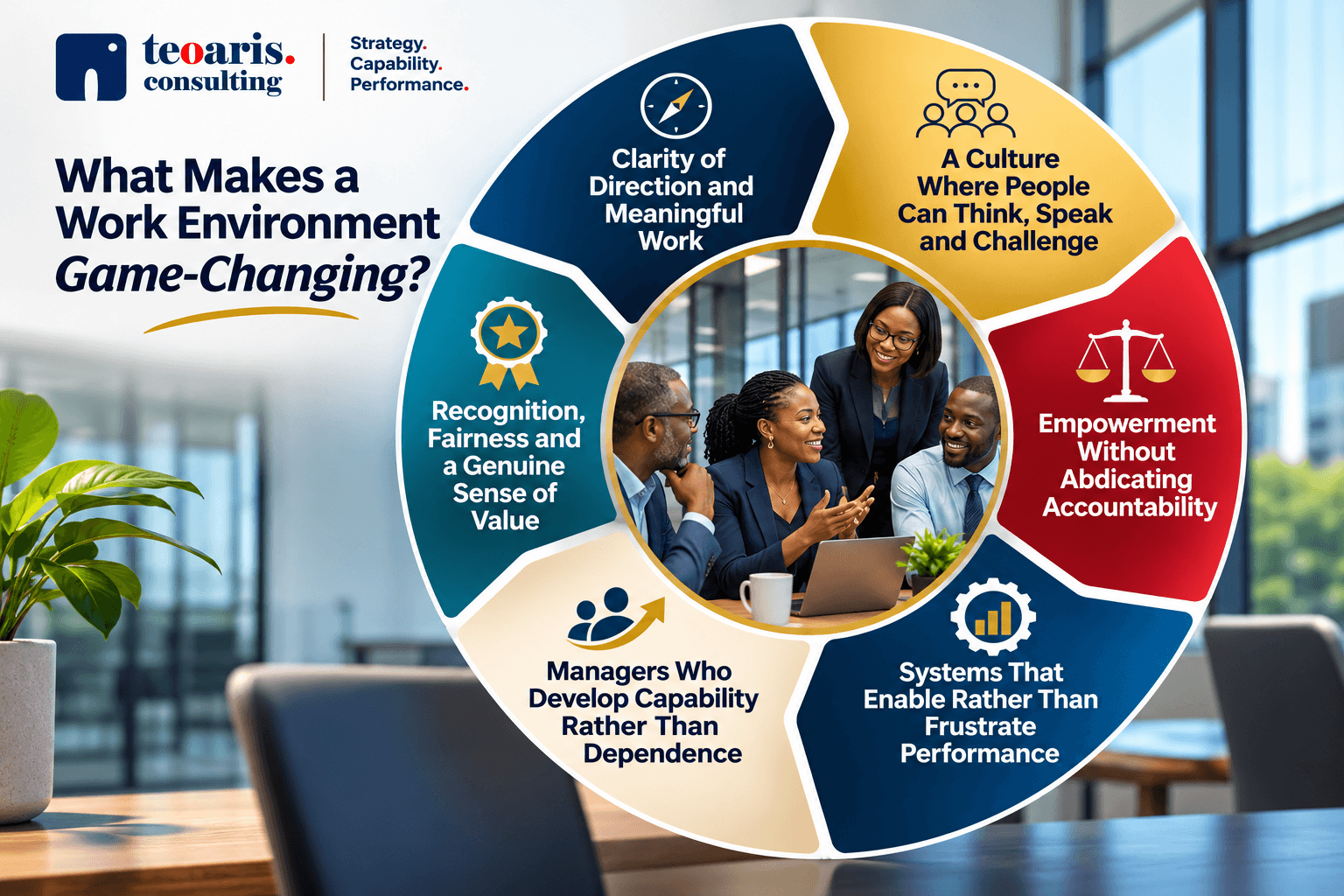
What Makes a Work Environment Game-Changing?
A truly game-changing work environment does more than make employees feel valued. It creates the conditions in which individual capabilities, collective intelligence and organisational resources combine to produce superior results.
Several elements are particularly important.
1. Clarity of Direction and Meaningful Work
People perform better when they understand what the organisation is trying to achieve, what is expected of them and how their contributions connect to broader business outcomes.
Unfortunately, many organisations communicate activities more effectively than they communicate purpose.
Employees know the tasks they must complete, the reports they must submit and the meetings they must attend. But they may have limited understanding of what those activities are ultimately intended to accomplish.
A game-changing environment provides clarity around strategic priorities, expected outcomes and individual responsibilities.
It helps employees move beyond simply completing assigned tasks to understanding the value those tasks are expected to create.
This distinction is essential.
When people understand the significance of their work, they are better positioned to identify opportunities for improvement, prioritise effectively and take responsibility for results.
Meaningful work is not necessarily glamorous work. It is work whose purpose, contribution and expected outcomes are understood.
2. A Culture Where People Can Think, Speak and Challenge
One of the most damaging conditions in any organisation is an environment where employees are afraid to speak honestly.
When questioning a decision is interpreted as disloyalty, identifying a problem is treated as incompetence, or challenging an assumption is perceived as disrespect, organisations begin to lose access to the intelligence of their own people.
Employees may continue attending meetings and fulfilling their responsibilities, but valuable information, alternative perspectives and potentially transformative ideas remain unexpressed.
Google’s research into team effectiveness, often associated with Project Aristotle, identified psychological safety as the most important of five dynamics characterising effective teams.
Psychological safety refers to an environment in which individuals feel able to raise concerns, ask questions, acknowledge mistakes and express ideas without fear of interpersonal humiliation.
But psychological safety should never be confused with the absence of standards.
A productive environment must combine openness with accountability.
People should be free to challenge ideas, but they must also be responsible for their contributions and performance.
The objective is neither a workplace where everyone agrees nor one where every disagreement becomes a confrontation.
It is an environment where the quality of an idea matters more than the seniority of the person expressing it.
3. Empowerment Without Abdicating Accountability
Many leaders say they want employees to demonstrate initiative. Yet their management practices frequently communicate the opposite.
They insist on approving routine decisions, intervene unnecessarily in operational matters and expect capable professionals to seek permission before taking reasonable action.
Over time, employees adapt.
They stop making decisions that could be questioned. They escalate matters they could ordinarily resolve. They become increasingly dependent on managerial direction.
Eventually, the leader becomes the organisation’s most significant operational bottleneck.
A game-changing environment reverses this pattern.
It establishes clear decision-making boundaries, delegates meaningful responsibility and allows people sufficient discretion to determine how best to achieve agreed results.
Toyota offers an instructive example.
Through its Toyota Production System, frontline workers have mechanisms for identifying production abnormalities and alerting supervisors through the Andon system so that problems can be addressed promptly.
The underlying principle is that those closest to the work should play an active role in identifying problems and protecting quality.
The lesson extends far beyond manufacturing.
Empowerment is not simply assigning responsibility. It is ensuring that people have the authority, information and support required to discharge that responsibility effectively.
And accountability must accompany that authority.

4. Systems That Enable Rather Than Frustrate Performance
Sometimes, poor employee performance is not primarily a people problem.
It is a work-design problem.
Employees may be expected to deliver excellent results while navigating cumbersome approval processes, unclear reporting relationships, inadequate tools, conflicting priorities and poorly coordinated departments.
Under such conditions, even highly committed individuals can struggle to be effective.
Microsoft’s 2025 Work Trend Index research highlighted the growing problem of fragmented work. In its analysis of Microsoft 365 activity, the company found that employees were interrupted, on average, every two minutes during core work hours by meetings, emails or notifications.
Although these findings relate to particular digital work environments, the broader challenge is familiar across industries: organisations can become so consumed by the mechanics of work that they undermine the very productivity those activities are intended to support.
In Nigeria, these challenges may be compounded by infrastructure constraints, unreliable power supply, inefficient technology, lengthy approval processes and other operational difficulties.
While leaders cannot eliminate every external constraint, they can determine how intelligently their organisations respond.
This requires regularly questioning the systems and practices through which work is accomplished.
Which approvals are genuinely necessary? Which reports support meaningful decisions? Which meetings add value? Where are employees repeatedly waiting for information, resources or authorisation?
An organisation should not measure its discipline by how many controls it has established, but by how effectively those controls support responsible performance.
5. Managers Who Develop Capability Rather Than Dependence
The immediate manager has an enormous influence on the employee experience.
A manager can create confidence or anxiety, encourage initiative or suppress it, develop professional judgement or foster dependence.
This makes managerial capability one of the most important determinants of the quality of an organisation’s work environment.
Yet many organisations promote employees into management primarily because they have demonstrated technical competence or outstanding individual performance.
The ability to perform a task exceptionally well does not automatically translate into the ability to lead others to perform it.
Effective managers must learn to establish expectations, coach employees, provide constructive feedback, handle difficult conversations, resolve obstacles and build team accountability.
They must also recognise when to intervene and when to allow employees sufficient space to develop their own judgement.
A manager who provides every answer may appear indispensable. But one who develops the ability of others to solve problems independently creates more enduring organisational value.
The objective should be to build teams that become progressively more capable, not progressively more dependent.
Great managers do not merely extract performance from their teams. They expand their teams’ capacity to perform.
6. Recognition, Fairness and a Genuine Sense of Value
Few things diminish commitment more quickly than an environment in which exceptional effort is ignored, underperformance is tolerated and opportunities appear disconnected from merit.
Employees observe what organisations reward, what they overlook and what they permit.
These observations often communicate more powerfully than formal statements about organisational values.
A game-changing workplace therefore requires credible systems of recognition, reward, advancement and accountability.
Performance expectations should be transparent. Contributions should be acknowledged. Opportunities for development should be meaningful. And employees should have confidence that decisions affecting them are guided by fair and reasonably consistent principles.
This does not mean that everyone must receive the same outcomes or that difficult performance decisions should be avoided.
It means employees should understand the standards by which decisions are made and believe those standards are applied with integrity.
Fairness is not simply an employee-relations issue. It influences trust, collaboration, discretionary effort and the willingness of people to invest their capabilities in the organisation’s success.
The Leadership Contradiction: Demanding What the Environment Discourages
Perhaps the most consequential leadership mistake is expecting behaviours that the organisation’s own environment systematically discourages.
Consider the contradictions:
An organisation demands innovation but punishes unsuccessful experiments.
It calls for ownership but requires approval for almost every meaningful decision.
It advocates collaboration but rewards internal competition and information hoarding.
It demands accountability but tolerates weak performance among influential employees.
It encourages employees to speak up but reacts defensively when they challenge senior management.
And it expects exceptional productivity while burdening employees with unnecessary bureaucracy and conflicting priorities.
In such circumstances, the problem is not simply that employees are failing to embrace organisational values.
The organisation itself is reinforcing behaviours that contradict its stated expectations.
Until those contradictions are addressed, motivational programmes, culture campaigns and additional training initiatives are unlikely to produce enduring improvements.
Leadership must examine not only what it expects employees to do, but also what the organisation’s systems, practices and management behaviours actually encourage them to do.
Building the Environment: Where Should Leaders Begin?
Creating a game-changing work environment does not require an immediate organisation-wide transformation programme.
It begins with a willingness to examine the conditions under which people work.
For CEOs and senior executives, five questions provide a useful starting point:
- Direction: Do our people clearly understand what matters most and how their work contributes to organisational success?
- Authority: Have we given employees sufficient decision-making responsibility, or have we institutionalised unnecessary dependence on managers?
- Leadership: Are our managers building confidence, judgement and capability in others, or merely supervising activities and enforcing compliance?
- Work Design: Which organisational processes, structures or management practices are making effective performance unnecessarily difficult?
- Performance Culture: Do our systems of recognition, reward and accountability genuinely reinforce the behaviours and outcomes we expect?
The answers should inform a deliberate improvement agenda.
That agenda may involve clarifying strategic priorities, redesigning decision rights, simplifying processes, developing managers, improving communication or strengthening performance management.
Importantly, progress must be measured. Employee feedback and engagement indicators provide valuable insights, but leaders should also examine operational outcomes such as decision-making speed, productivity, employee retention, customer experience, service quality and execution effectiveness.
A genuinely improved workplace should ultimately demonstrate its value through both a better employee experience and stronger organisational performance.
The Real Test of a Great Work Environment
A game-changing work environment is not one in which employees are constantly happy, pressure is absent or difficult decisions are avoided.
Every serious organisation must confront performance demands, operational challenges, resource constraints and periods of uncertainty.
The real test is whether its environment enables people to respond to those demands with competence, confidence, responsibility and a willingness to improve.
Does it encourage employees to bring their judgement to work, rather than merely their presence?
Does it make collaboration easier than internal competition?
Does it support learning without compromising standards?
Does it create opportunities for capable people to grow, contribute and make a meaningful difference?
And perhaps most importantly, does it help the organisation achieve results that would have been difficult to attain through individual effort alone?
These are the characteristics that distinguish an ordinary workplace from a genuinely high-performing one.
Ultimately, exceptional organisational performance is not simply a function of recruiting exceptional people. It is also a consequence of creating an environment in which ordinary people can achieve extraordinary things together.
The responsibility for building such an environment rests fundamentally with leadership.
Because while employees are accountable for how they perform, leaders must also be accountable for the conditions under which that performance is expected.
You cannot expect exceptional performance from an environment that stifles it.