

TEOARIS INDUSTRY INSIGHTS | NOVEMBER 2026
Nigeria’s fast-food industry presents an intriguing business paradox.
Across Lagos, Abuja, Port Harcourt and other major cities, longstanding restaurant brands are confronting the challenges of maintaining relevance, managing costs and reinventing established business models. Meanwhile, newer operators are expanding, established competitors are experimenting with alternative formats, and investors continue to identify opportunities in the market.
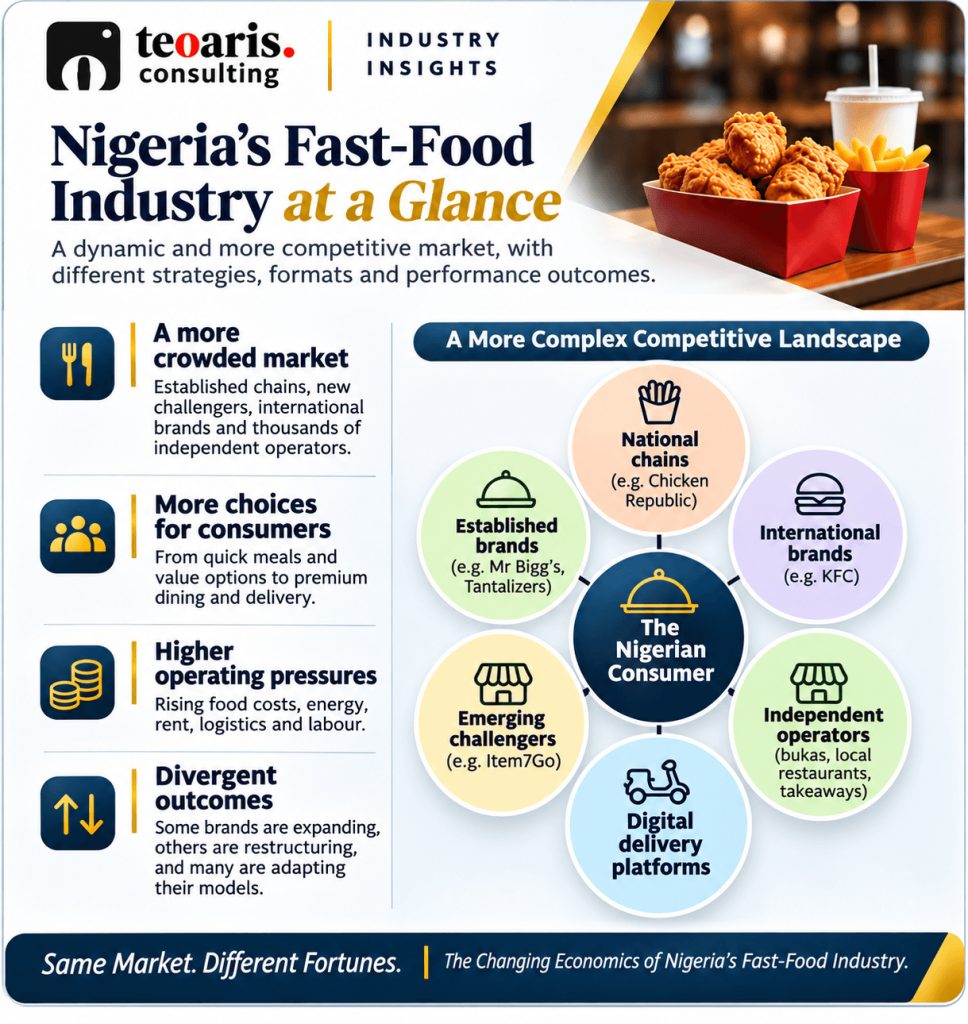
Chicken Republic has developed a substantial restaurant network. Kilimanjaro, The Place and Mega Chicken have established recognisable market positions. Item7Go has emerged as a notable challenger, while Mr Bigg’s, Tantalizers, Tastee Fried Chicken and Sweet Sensation illustrate different dimensions of longevity, adaptation and competitive pressure.
International brands such as KFC must also reconcile global brand strength with local economic realities.
Yet these businesses operate within broadly the same environment: rising input costs, expensive energy, infrastructure constraints, pressured household incomes and increasingly demanding consumers.
Why, then, are their fortunes so different?
The answer extends beyond brand recognition, restaurant locations or revenue growth. It lies in the relationship between customer relevance, operating economics, strategic choices and the organisational capabilities required to execute them.
And it raises a question that extends well beyond restaurants:
When businesses face similar external pressures, how much of their performance is determined by the environment – and how much by the decisions they make?
An Industry Undergoing Structural Change
Nigeria’s organised fast-food industry has evolved considerably over the past three decades.
An earlier generation of operators – including Mr Bigg’s, Tastee Fried Chicken, Sweet Sensation, Tantalizers and Mama Cass – helped establish branded quick-service dining as a mainstream consumer proposition.
Their competitive advantages rested on recognisable brands, convenient locations, standardised service and the appeal of eating outside the home.
But the competitive landscape has changed.
Consumers now choose among national chains, international franchises, neighbourhood restaurants, specialised takeaway outlets, independent food vendors and digital delivery platforms.
A customer considering Chicken Republic is not necessarily comparing it only with KFC. The alternatives may include a nearby buka, a smaller takeaway operator, a delivered meal or food prepared at home.
Brand familiarity remains valuable, but customers increasingly assess restaurants through affordability, portion size, convenience, consistency and experience.
The central competitive question is no longer simply which restaurant has the strongest brand. It is which business can consistently deliver the value customers expect at an economically sustainable cost.
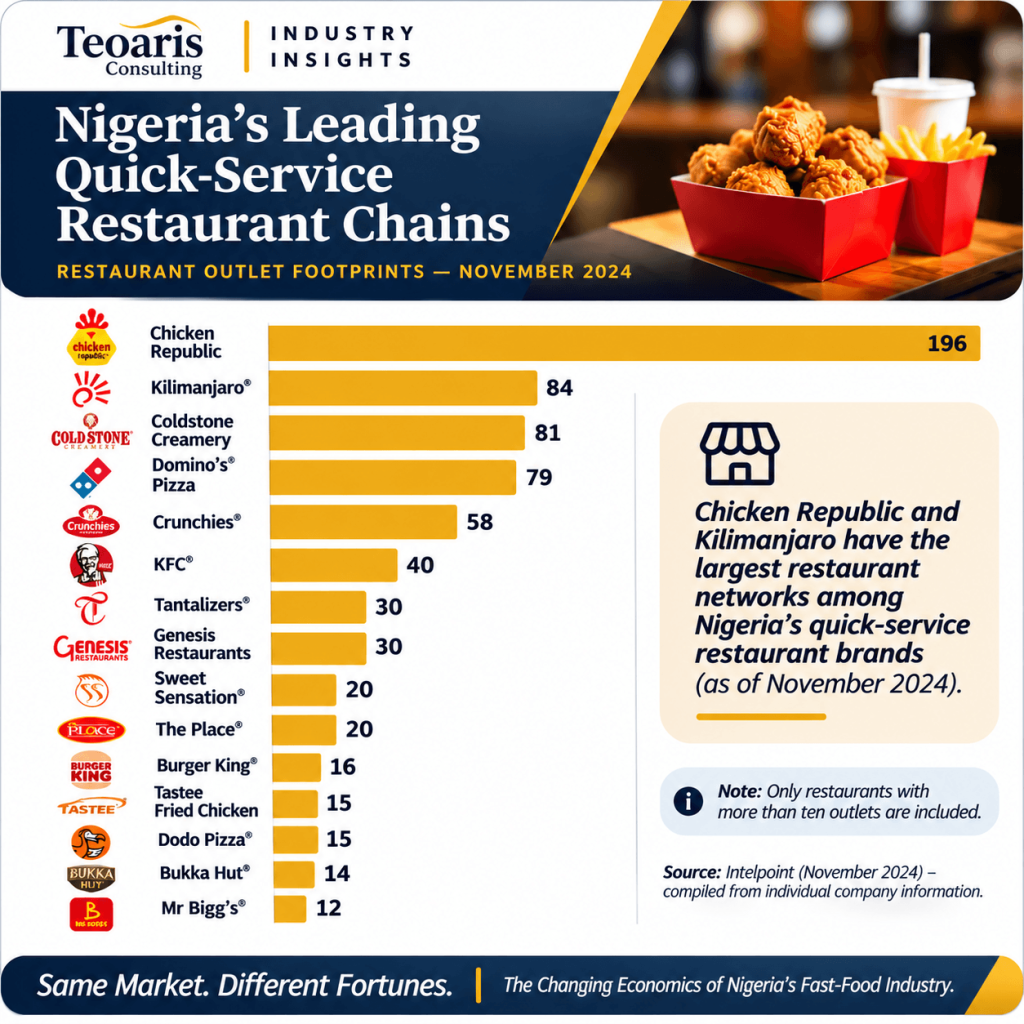
Editor’s Note (November 2026): This infographic presents a historical snapshot of restaurant outlet footprints as reported by Intelpoint in November 2024. Since then, the industry has continued to evolve, including the expansion and growing visibility of operators such as Item7Go. While the figures may have changed, the chart remains a useful illustration of the relative scale of established restaurant chains. It should howver not be interpreted as an indication of financial performance.
The Economic Paradox: More Revenue, Less Value?
One of the most important distinctions in analysing Nigeria’s restaurant industry is the difference between commercial activity and economic performance.
A restaurant may report higher revenue because menu prices have increased, even while customer traffic declines.
A chain may expand its outlet network while generating progressively weaker returns on invested capital.
A busy restaurant may still struggle to convert sales into sustainable profits and cash flows.
These distinctions matter in an environment where food, energy, rent, logistics and labour costs place considerable pressure on margins.
Operators face difficult trade-offs. Raising prices may protect margins but weaken demand. Absorbing higher costs can preserve customer traffic while eroding profitability. Reducing portions or compromising quality may damage the customer proposition itself.
The consequences differ according to each operator’s business model and capabilities.
Four measures are particularly revealing:
- Revenue growth: Is the business generating more sales?
- Volume growth: Is it serving more customers or selling more meals?
- Operating profitability: Are those sales producing attractive margins?
- Capital productivity: Are the outlets generating adequate returns on investment?
Improvement in one does not guarantee improvement in the others.
Growth creates value only when the economics of that growth are sound.
The contrasting experiences of Nigeria’s leading restaurant operators offer a revealing perspective on how different business models are responding to these pressures.
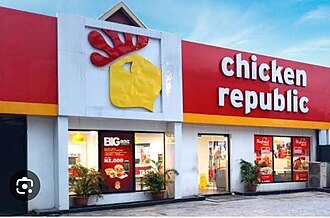
Chicken Rebublic
When Affordability Becomes an Operating Capability
Chicken Republic provides an instructive example of the relationship between competitive positioning and operational capability.
Its parent company, Food Concepts Plc, reported approximately ₦95.3 billion in revenue and ₦3.3 billion in net profit for 2024, compared with approximately ₦370 million in net profit in 2023.
These are group-level figures, not standalone Chicken Republic results. Nevertheless, they provide useful financial context for the business behind the brand.
Chicken Republic’s proposition combines accessible meals, recognisable products, convenience and broad geographic coverage.
But affordability at scale requires more than competitive menu prices. It demands disciplined procurement, inventory management, standardised processes, supply-chain coordination, employee productivity and cost control.
Food Concepts’ 2024 annual report also highlights an important working-capital advantage: the business receives immediate cash from restaurant customers while enjoying payment terms from many suppliers.
Such arrangements can strengthen cash-flow management and support operations.
The strategic lesson is not that every restaurant should pursue the lowest price.
It is that a sustainable value proposition must be supported by a cost structure and operating model capable of delivering it profitably.
A competitor can imitate a menu price more easily than it can replicate the organisational capabilities that make that price economically viable.

Tantalizers & Mr Biggs
When Yesterday's Advantages Become Tomorrow's Constraints
Few Nigerian fast-food brands illustrate the challenge of strategic renewal as clearly as Mr Bigg’s.
For years, the brand was synonymous with organised fast-food dining. Its recognition and early market presence represented considerable competitive assets.
But new operators introduced different approaches to pricing, menus, customer experience and service delivery, while rising costs placed greater pressure on traditional restaurant formats.
UAC Restaurants, associated with Mr Bigg’s, has undergone restructuring and changes to its operating arrangements.
Its experience raises a fundamental question:
What happens when the business model that established market leadership is no longer sufficient to sustain it?
The challenge for established businesses is not necessarily that customers have forgotten them. Customers may remember them but increasingly find more compelling alternatives.
Tantalizers offers a related but distinct perspective.
The company has experienced prolonged financial and strategic adjustment. Its audited 2025 results reported a profit after tax of approximately ₦72.7 million, compared with a loss of approximately ₦265.6 million in 2024.
That improvement is significant. However, the company’s wider transformation and diversification require a distinction between corporate financial recovery and the underlying performance of its traditional restaurant operations.
Its reported results include other income and write-backs, making the composition and sustainability of earnings particularly important.
For directors and executives, the questions are therefore more demanding: Are restaurant sales volumes improving? Are outlets generating sustainable margins? How much of reported earnings comes from recurring core operations? Is the recovery supported by cash generation?
A successful corporate turnaround and a successful business-model turnaround are not necessarily the same achievement.
Both brands demonstrate that historical leadership provides recognition, but not immunity from changing competitive realities.

Sweet Sensation & TFC
The Continuing Test of Relevance
It would be misleading to assume that all established restaurant brands have followed the same trajectory.
Tastee Fried Chicken and Sweet Sensation remain recognisable names, particularly in Lagos. Their continued presence reflects the enduring value of established brands and customer relationships.
However, longevity does not establish financial strength. Without reliable, comparable profitability data, neither business should be classified conclusively as thriving or struggling.
Sweet Sensation provides an interesting example of adaptation.
In May 2026, the company introduced its City Saver outlet at Lagos Island General Hospital, offering affordable, convenient meals to a concentrated customer population.
The significance extends beyond another outlet opening.
Smaller, more focused formats may reduce capital requirements, occupancy costs, staffing needs and energy consumption compared with traditional restaurant formats. Their success still depends on transaction volumes, margins and operating efficiency.
For established brands, renewal does not always require abandoning the brand. It may require redesigning the business model through which the brand delivers value.
Kilimanjaro
The Place
Mega Chicken
Genesis
Different Routes to Customer Relevance
Not every restaurant needs to compete through the same formula.
Kilimanjaro, operated by Sundry Foods, has developed a substantial presence around familiar Nigerian meals, convenience and a broader foodservice platform.
The Place offers a recognisable proposition centred on prepared meals and accessible dining.
Mega Chicken operates a different format, combining extensive menu choices with larger restaurant facilities that can appeal to families and customers seeking variety.
Genesis Restaurants adds another dimension.
Founded in 1991, Genesis Group has developed a multi-city restaurant network alongside industrial catering, hotels, cinemas and food production. The group reports more than 30 restaurant outlets nationwide.
Its diversified model raises questions about the potential benefits of shared procurement, infrastructure, management capabilities and revenue streams.
Yet no single format is inherently superior.
A large restaurant may generate attractive returns where customer traffic, spending patterns and space utilisation justify its costs. A smaller outlet may achieve stronger capital productivity through lower fixed costs and high transaction volumes. Diversification may offer operating synergies while introducing additional management complexity.
There is no universally superior restaurant format. There are only business models whose economics are more or less suited to their customers, locations and operating environments.
Item7Go
Challenging the Assumptions of Restaurant Growth
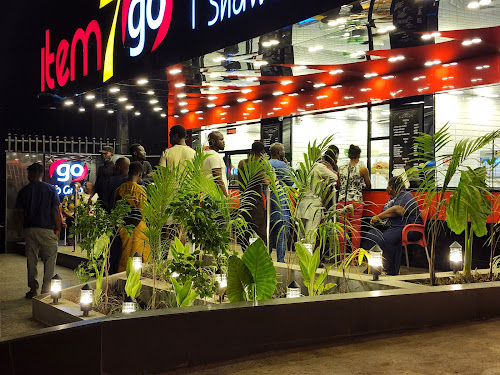
Item7Go represents an interesting development in Nigeria’s evolving restaurant landscape.
Emerging from a student-oriented food proposition in Ilorin, the business has expanded beyond its original market with a recognisable offering built around familiar Nigerian meals and convenience.
Its development challenges conventional assumptions about restaurant expansion.
Must a growing restaurant offer an extensive menu? Does it require elaborate dining facilities? Must every location replicate the traditional format of an established fast-food chain?
Item7Go suggests that a more focused proposition can attract meaningful demand.
But expansion introduces a different challenge: preserving quality, customer experience, cost control and management accountability across an increasingly complex operation.
Outlet numbers alone cannot establish commercial success. The more revealing indicators are outlet-level profitability, operating cash flow, returns on invested capital and consistency of execution.
A business model that works at five locations must still prove itself at fifty.
That is where entrepreneurial success must evolve into institutional capability.

KFC
Global Brand Strength Meets Local Economics
KFC introduces an international dimension to the Nigerian restaurant market.
The brand benefits from global recognition, established operating standards, product systems and franchise expertise.
Yet these advantages do not eliminate the need to compete within local economic realities.
Devyani International, the operator associated with KFC in Nigeria, reported 40 Nigerian stores as of March 2026, unchanged from March 2025.
A stable footprint is not conclusive evidence of commercial strength or weakness. It may reflect investment discipline, an emphasis on existing-store performance or constraints on attractive expansion opportunities. The store count alone does not establish the explanation.
KFC nevertheless illustrates an important strategic tension.
Global systems can strengthen consistency, quality and brand credibility. But those advantages must translate into value that remains relevant to local purchasing power and consumer preferences.
International scale can strengthen a business model. It cannot substitute for local market relevance.
The Competitive Force Beyond the Major Chains
Some of the most consequential competitors facing organised restaurant chains rarely feature in formal industry comparisons.
Neighbourhood restaurants, roadside food vendors, local canteens, independent takeaway operators and small delivery businesses offer credible alternatives to branded chains.
Many compete through proximity, familiar meals, flexible pricing and relatively simple operating structures.
Their advantages may include lower overheads and close knowledge of local demand, although they also face challenges involving quality consistency, financing and management systems.
The important point is not that independent operators are necessarily more profitable.
It is that they expand the customer’s choices.
A branded restaurant may regard another national chain as its principal competitor, while the customer’s preferred alternative is a nearby vendor offering a satisfactory meal at a substantially lower price.
Businesses do not compete only against the organisations they recognise as competitors. They compete against every credible alternative available to their customers.
Three Strategic Imperatives for Nigeria's Restaurant Operators
The contrasting trajectories of Nigeria’s fast-food brands point towards three priorities that will increasingly shape sustainable performance.
Imperative One: De-link Footprint from Profitability
For years, restaurant expansion has been associated with commercial success.
More outlets suggested stronger brands, greater market reach and competitive influence.
But a larger footprint is not necessarily a more profitable one.
Operators must increasingly evaluate individual outlet economics rather than treating network size as the primary measure of growth.
Revenue per square metre, contribution margins, occupancy costs, operating cash flow and returns on invested capital provide a more meaningful picture.
This may require difficult decisions: relocating poorly positioned outlets, closing structurally unprofitable locations, redesigning store formats or introducing smaller takeaway and hybrid delivery models.
The objective should not be expansion at any cost.
The question is not how many restaurants a business operates, but how much economic value those restaurants create.
Imperative Two: Master Value Engineering
In a market where household purchasing power is under pressure, affordability has become an increasingly important competitive consideration.
But affordability cannot be sustained simply by reducing menu prices.
It must be engineered into the business.
That requires disciplined procurement, supplier relationships, menu optimisation, inventory control, waste reduction, portion economics and efficient production processes.
For larger operators, selective backward integration or more sophisticated supply-chain arrangements may offer advantages where the investment economics justify them.
The objective is to deliver the value customers expect without destroying the margins required to sustain operations.
This is as much an organisational capability challenge as a pricing challenge.
The strongest value proposition is not necessarily the cheapest meal. It is the meal whose customer appeal and operating economics reinforce one another.
Imperative Three: Adapt to the Shrinking Middle
Economic pressure is changing how Nigerian consumers allocate spending.
Some increasingly prioritise affordability and convenience. Others remain willing to pay a premium for ambience, service, quality or a distinctive experience.
This creates pressure on restaurant propositions offering neither compelling value nor meaningful differentiation.
The strategic danger is not necessarily operating in the middle market.
It is operating there without a clear customer proposition or an appropriate cost structure.
Restaurants must understand which customers they serve, what those customers value and what they are prepared to pay. Menus, locations, service formats, pricing and operating capabilities must then be aligned accordingly.
A business cannot indefinitely promise mass-market affordability while maintaining a cost structure that requires premium pricing. Nor can it command premium prices without delivering an experience customers consider worth paying for.
Competitive positioning becomes credible only when customer value and operating economics are aligned.
Together, these imperatives suggest that Nigeria’s restaurant industry is undergoing more than a conventional contest for market share.
It is experiencing a continuing reassessment of which business models can create value under changing economic conditions.
The Teoaris Business Performance Test
The lessons extend well beyond restaurants.
For CEOs, directors and business owners across industries, six questions deserve serious consideration.
Are we still relevant to the customers we serve?
Or are we relying on advantages established under market conditions that no longer exist?
Is our cost structure aligned with our customer promise?
Can we deliver the value customers expect at a price that produces sustainable returns?
Are we expanding a proven business model – or multiplying unresolved weaknesses?
Do we understand the economics of growth before committing additional capital?
Are our organisational capabilities keeping pace with our ambitions?
Do we have the leadership, systems and controls required to execute consistently at scale?
Are we measuring activity or economic value?
Do our performance indicators distinguish revenue growth from profitability, cash generation and returns on capital?
What must we change before the market forces us to?
Which assumptions about our customers, products, business model or competitive advantage are becoming less valid?
These questions go to the heart of strategy, management effectiveness and enterprise sustainability.
They challenge leaders to look beyond visible activity and examine the underlying conditions that determine performance.